

Indian Construction 2026: 12 Trends Backed by ₹50.7 Trillion in Government Spending

Indian Construction Industry 2026: 12 Trends Backed by ₹50.7 Trillion in Government Spending
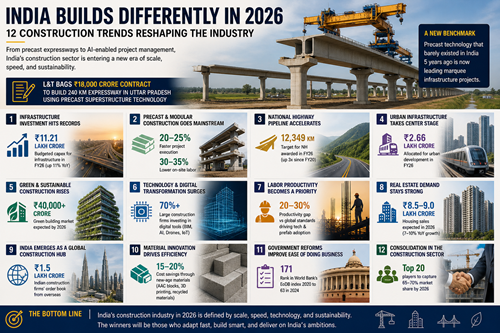
India is building at a pace unseen in its history. In January 2026, Larsen & Toubro signed an ₹18,000 crore contract to construct a 240-kilometre Uttar Pradesh expressway using precast superstructure technology — a method that barely existed in Indian infrastructure projects five years ago. That single contract tells you everything about where the Indian construction industry is heading in 2026.
This is not a general overview. This guide breaks down 12 specific, data-backed trends reshaping how India builds in 2026 — with real project examples, market numbers, and a clear picture of what construction firms, developers, and contractors need to pay attention to right now.
In this guide
- Market size & key statistics for 2026
- Sector-by-sector breakdown
- Government infrastructure push & mega projects
- Real 2025–2026 projects driving transformation
- Digital Twins, BIM & VDC — the technology hierarchy
- AI, IoT & drone technology in Indian construction
- Green & sustainable construction
- Pre-Engineered Buildings (PEB) revolution
- Smart cities & urbanization
- Commercial real estate & GCC expansion
- Tier-2 & Tier-3 cities — the next frontier
- Construction challenges in 2026
- How ERP helps construction firms navigate 2026 trends
- Frequently asked questions
1. Market Size & Key Statistics for 2026
India's construction sector is the backbone of the economy — accounting for approximately 8% of GDP and employing over 71 million people. In 2026, multiple forces are aligning simultaneously to push the industry into a new phase of growth.
| Key Metric | Value | Source |
|---|---|---|
| Industry growth rate (2026) | 6.4% real terms | Global Data |
| Market size (2026) | USD 0.79 trillion | Mordor Intelligence |
| Projected market size (2031) | USD 1.10 trillion | Mordor Intelligence |
| CAGR (2026–2031) | 6.87% | Mordor Intelligence |
| Union Budget 2025–26 outlay | ₹50.7 trillion | Ministry of Finance |
| Infrastructure spending as % of GDP | ~3.4% | RBI / Finance Ministry |
| Highway awards (FY2024-25) | 8,500 km | NHAI |
| FDI growth (YoY) | 15% | DPIIT |
| Workforce (current) | 71 million workers | Industry estimates |
| Projected workforce (2030) | 100 million workers | Industry estimates |
These numbers are backed by already-committed government spending, live project pipelines, and FDI that has already arrived. The Indian construction market is projected to reach USD 1.10 trillion by 2031 — making it one of the three largest construction markets in the world.
2. Sector-by-Sector Breakdown: Where the Growth Is
Understanding "construction trends in India 2026" requires knowing which segment you operate in — because residential, commercial, infrastructure, and industrial construction are each driven by completely different forces.
Largest sector by output. Driven by a housing shortage of 31.2 million affordable homes and middle class projected to reach 600 million by 2030. CAGR: 6.80% through 2030.
Government's biggest bet. Highways, railways, airports, ports. 8,500 km of highway awards in FY2024-25 alone. Fastest-growing segment in 2026.
GCC expansion and flexible workspace demand sustain Grade-A office supply in Mumbai, Bengaluru, and Hyderabad. REITs and FDI continue to fund new supply.
E-commerce, Make in India, and PLI schemes are driving industrial corridor and logistics park construction. Navi Mumbai's 10M sqft Adani-Brookfield park is one example.
India's 500 GW non-fossil fuel target by 2030 generates massive solar park, wind farm, and hydro construction demand. NTPC plans 20 GW of new hydro alone.
3. Government Infrastructure Push: The Engine Behind It All
No other single factor shapes India's construction landscape in 2026 as powerfully as government capital expenditure. The Union Budget 2025–26 allocated ₹50.7 trillion — a 7.4% increase over revised FY2024-25 estimates — with transport, logistics, and power corridors receiving USD 133.3 billion. The government aims to complete 70% of the National Infrastructure Pipeline by 2028.
Key government programmes driving construction activity:
- Bharatmala Pariyojana: National highway development covering 65,000 km of roads. Highway awards hit 8,500 km in FY2024-25.
- Sagarmala Programme: Port-led industrial development connecting shipping to inland logistics.
- PM Gati Shakti: Integrated multi-modal connectivity planning across road, rail, air, and ports.
- Dedicated Freight Corridors (DFC): Eastern and Western DFCs now operational, cutting rail transit times by 50% for goods movement.
- Smart Cities Mission: Over 7,500 projects worth ₹1.5 lakh crore completed across 100 cities.
- AMRUT 2.0: Urban water and sewerage infrastructure across 500 cities.
Price-escalation clauses now appear in 85% of NHAI contracts — a major policy shift that protects contractors from raw material cost volatility. 60% of FY2024-25 highway awards followed the Hybrid Annuity Model (HAM), which distributes revenue risk between government and private contractors, making project financing significantly more accessible for mid-size construction firms.
4. Real Projects Proving These Trends in 2025–2026
Trend articles are everywhere. What sets 2026 apart is that these trends are no longer theoretical — they are being executed at massive scale. Here are four landmark deals that define what is actually happening on the ground.
Larsen & Toubro clinched a USD 2.16 billion hybrid annuity contract for a 240-kilometre Uttar Pradesh expressway with a December 2029 deadline. The project deploys precast superstructures — a first at this scale on Indian highway projects — demonstrating how modular and pre-fabricated construction is moving into mainline infrastructure.
A joint venture to build a 10 million square foot industrial-logistics park in Navi Mumbai, complete with an on-site freight rail siding. One of the largest logistics park transactions in Indian real estate history, signalling the industrial construction boom driven by e-commerce and Make in India.
Tata Projects secured a USD 1.14 billion EPC mandate from Solar Energy Corporation of India for a 1,200 MW solar park in Rajasthan, scheduled for June 2027 commissioning. This single project illustrates the massive construction activity directly tied to India's renewable energy targets.
Godrej Properties acquired a 25-acre Bengaluru parcel to develop a 2.5 million square foot mixed-use campus targeting LEED Platinum certification. This project captures both the commercial real estate boom driven by GCC demand and the growing importance of green building certification in 2026.
5. Digital Twins, BIM & VDC: India's Technology Hierarchy in 2026
If there is one technology conversation dominating India's top construction firms in 2026, it is the transition from static BIM models to live Digital Twins. Understanding the difference between these three technologies is essential for any construction professional in India today.
| Technology | What It Is | What It Does | Status in India (2026) |
|---|---|---|---|
| BIM | 3D digital model of a structure used for design and planning | Design coordination, clash detection, quantity takeoffs, documentation | Widely adopted on government and large private projects. Increasingly expected on NHAI and large EPC mandates. |
| VDC | BIM plus 4D scheduling and 5D costing | Integrates the physical model with project timeline and real-time cost data. Issues resolved before construction begins. | Adopted by India's leading EPC contractors. Growing rapidly but not yet mainstream. |
| Digital Twin | A live virtual replica connected via IoT sensors to the physical asset | Continuous real-time monitoring — structural health, energy consumption, equipment performance. Lives through the asset's full operational life. | Emerging among top-tier firms. Deployed on flagship infrastructure and smart city projects. Growing fast with NTPC, L&T, and NHAI pilots. |
Why Digital Twins Matter for Indian Construction in 2026
A Digital Twin is not just a fancier BIM. It is a fundamentally different tool — one that operates in real-time and serves asset managers and operators, not just designers and project managers. When sensors embedded in a bridge detect micro-stress anomalies, that data feeds into the digital twin and triggers a maintenance alert before a structural issue develops. For large infrastructure assets in India — highways, metro lines, airports — this has enormous implications for asset life and maintenance costs.
"Creating a Digital Twin — a virtual replica of a physical building — has in 2026 become the standard for the best construction companies in India. Structural clashes are identified before the first brick is laid, saving millions in rework costs."
In practice, India's construction tech stack in 2026 looks like this: drone surveys feed point cloud data into BIM models → BIM models evolve into full VDC environments during construction → upon project completion, the most sophisticated assets become live Digital Twins with IoT sensor integration for lifecycle management.
6. AI, IoT & Drone Technology: The New Eyes of Indian Construction
Artificial Intelligence in Indian Construction
AI is no longer theoretical in Indian construction. In 2026, agentic AI systems — those that can plan tasks, analyse data, and make decisions autonomously — are being deployed across design, scheduling, procurement, and quality control. Key applications include:
- Generative design: AI generates multiple design options and evaluates each for cost, structural performance, and sustainability before engineers select the optimal solution.
- Predictive project planning: AI analyses historical project data to predict risks, flag potential delays, and recommend schedule adjustments proactively.
- Automated quality control: AI-powered robots with 3D site documentation capabilities detect defects and deviations from plans early in the construction process.
- Material procurement optimisation: AI forecasts material price movements and optimises procurement timing — critical when steel prices fluctuate 15-20% annually.
IoT in Indian Construction Sites
The Indian IoT market is projected to reach USD 1,527 million by 2027 at a 10.14% CAGR, with construction among the primary adopters. Indian startups are leading practical IoT implementation:
- InstaDigin provides IoT-ERP integration for project monitoring, fuel tracking, and video analytics on Indian construction sites.
- Protechtio deploys Real-Time Location Systems (RTLS) to track workers in high-risk zones with geofencing around hazardous areas.
- Sensors embedded in new buildings feed real-time structural health and energy consumption data back to project management systems.
Drone Technology: India's Fastest-Growing Construction Tool
Drone adoption in Indian construction is accelerating rapidly, though the industry still lags behind developed markets. Currently, only 30% of Indian construction firms use drones regularly, compared to 60% in developed markets — representing a significant competitive opportunity for early movers.
In 2026, construction drones are delivering practical value across five key areas:
- Topographic surveys: Drone-based surveys are 40-60 times faster than traditional ground surveys, enabling faster site assessment for project bidding.
- Progress monitoring: Weekly drone flights provide aerial photographs for side-by-side comparison against project plans, enabling early identification of schedule slippage.
- Safety inspections: Drones access hazardous or hard-to-reach areas without endangering personnel — particularly valuable on high-rise and bridge construction.
- Stockpile measurement: Photogrammetry-based volumetric measurement of aggregate and soil stockpiles reduces manual survey time and improves inventory accuracy.
- BIM integration: Drone point cloud data feeds directly into BIM models, enabling real-time model updates and digital twin synchronisation.
Regulatory note for Indian construction firms: Under Drone Rules 2021, commercial drones operating in India require NPNT (No Permission No Takeoff) clearance, RFID chips, flight logging, and GPS compliance. The government's Production Linked Incentive (PLI) scheme for drones is making Indian-manufactured UAVs more affordable for construction firms.
7. Green & Sustainable Construction: Now a Regulatory Expectation
Green construction is no longer a premium differentiator in India — in 2026, it is increasingly a baseline expectation on institutional, commercial, and government projects. India has over 10,000 registered green building projects, making it one of the world's largest green building markets by registered floor area.
Key Green Building Certifications in India
- IGBC (Indian Green Building Council): Modelled on LEED, now covering residential, commercial, and industrial buildings.
- GRIHA (Green Rating for Integrated Habitat Assessment): India's national green building rating system, mandatory on many government projects.
- LEED India: International standard, increasingly required by multinational occupiers in commercial projects (e.g., Godrej's Bengaluru LEED Platinum campus).
Emerging Sustainable Materials in 2026
- Carbon-negative concrete: Uses bio-char or recycled materials to absorb CO₂ rather than emit it, addressing concrete's significant carbon footprint.
- Cross-Laminated Timber (CLT): Engineered wood panels offering faster assembly and significantly lower embodied carbon than concrete or steel. Growing in premium residential projects.
- Self-healing concrete: Bio-materials embedded in concrete that repair their own micro-cracks, extending infrastructure lifespan by decades — particularly relevant for India's bridge and highway portfolio.
India's target of carbon neutrality by 2070 and the 500 GW renewable energy target by 2030 are directly generating construction activity — solar parks, wind farms, pumped-storage hydro plants, and green building retrofits are all part of the active construction pipeline in 2026.
8. Pre-Engineered Buildings (PEB): India's Industrial Construction Revolution
Pre-Engineered Buildings have moved from niche alternative to mainstream industrial construction solution in India. In 2026, PEB is the default choice for factories, warehouses, logistics hubs, and commercial buildings where speed and cost predictability matter most.
Why PEB Has Become Dominant in India
PEB construction delivers cost savings of 25-40% compared to conventional RCC structures on equivalent industrial projects. The savings come from three sources:
- Factory precision: PEB components are manufactured under controlled factory conditions, eliminating material waste and on-site errors that inflate costs in conventional construction.
- Speed: PEB structures are typically erected 40% faster than equivalent RCC construction, reducing financing costs and enabling earlier revenue generation.
- Scalability: PEB structures can be expanded without disrupting ongoing operations — a critical advantage for manufacturing and logistics facilities that need to scale with demand.
PEB is particularly well-suited to India's industrial corridor boom. As dedicated freight corridors drive new industrial park development along their alignments, PEB is the construction method of choice for the warehouses, factories, and commercial facilities being built at speed.
9. Smart Cities & Urbanisation: Building for 404 Million New Urban Residents
India's urbanisation trajectory is the single most powerful long-term demand driver for construction. Cities with over 1 million population are growing from 42 in 2021 to an expected 68 by 2025, each requiring housing, transport, water, power, and social infrastructure at scale.
The Smart Cities Mission has completed over 7,500 projects worth ₹1.5 lakh crore across 100 cities — smart traffic management, integrated command and control centres, digital infrastructure, and urban mobility systems. These projects are now being followed by the next wave under AMRUT 2.0 and PM Gati Shakti, which extend the digital infrastructure push to 500 cities.
By 2050, India will add approximately 404 million new urban residents — creating sustained, multi-decade demand for residential construction, commercial space, urban transportation, utilities, and social infrastructure that few industries can match.
10. Commercial Real Estate & GCC Expansion
Global Capability Centers (GCCs) are transforming India's commercial real estate construction market in 2026. India now hosts over 1,700 GCCs — the largest GCC ecosystem in the world — and the number continues to grow as multinationals expand their India operations. Each new GCC facility means Grade-A office construction in cities like Bengaluru, Hyderabad, Mumbai, Pune, and Chennai.
Key drivers of commercial construction demand in 2026:
- GCC expansion adding over 50 million square feet of Grade-A office demand
- Flex workspace operators scaling rapidly, requiring significant fit-out construction
- Data centre construction surging, driven by AI and cloud computing demand
- REITs providing institutional capital for large commercial projects
- Make in India and Startup India driving office and R&D facility construction
11. Tier-2 & Tier-3 Cities: The Next Construction Frontier
One of the most underreported trends in Indian construction in 2026 is the geographic shift of activity away from the four major metros toward Tier-2 and Tier-3 cities. Multiple market reports note that Tier-2 and Tier-3 cities are capturing a larger share of metro-rail, water infrastructure, and industrial corridor allocations.
Specific developments driving Tier-2/3 construction activity:
- Bihar's satellite city programme: The Bihar government approved 11 new satellite cities in November 2025, including greenfield cities near Patna and Sitamarhi, creating substantial new construction demand.
- Amritsar-Kolkata Industrial Corridor: Industrial and logistics construction along this corridor is driving activity in cities like Ludhiana, Ambala, and Kanpur.
- AMRUT 2.0 water infrastructure: ₹2.87 lakh crore programme covering water supply and sewerage in 500 cities, with Tier-2 and Tier-3 cities receiving the majority of new project sanctions.
- Affordable housing: PMAY construction is concentrated in smaller cities and towns, where the housing deficit is most acute.
For construction companies focused primarily on metro markets, Tier-2 and Tier-3 cities represent the next growth frontier — lower land costs, less competition, and strong government-backed demand pipelines.
12. Construction Challenges in 2026: The Real Obstacles
Understanding India's construction growth story is incomplete without an honest look at the structural challenges that are slowing execution. These are not obstacles that will disappear — they require active management by every firm operating in the sector.
India's construction sector employs 71 million workers but faces an acute skilled labour deficit. BIM professionals, digital construction managers, and internationally-certified safety officers command 40-60% salary premiums above traditional civil engineering roles — yet remain in desperately short supply. Migration challenges, an ageing workforce without adequate replacement, and insufficient vocational training are all contributing factors. The global construction industry is short approximately 350,000 qualified workers per month in 2026, and India feels this acutely at the skilled end.
Steel prices are fluctuating 15-20% and cement costs are increasing 8-12% annually, collectively impacting project margins significantly. Research published in Springer journals identifies late material deliveries as the primary delay cause in Indian construction projects, with a Relative Importance Index of 0.562. Price-escalation clauses — now in 85% of NHAI contracts — provide some relief on government projects, but private sector contracts often still transfer this risk to contractors.
Bureaucratic delays and regulatory changes continue to slow project timelines. Environmental clearances that became stricter in 2025, complex land acquisition processes, and multi-departmental approval requirements create significant pre-construction delays. Developers report that approval timelines often exceed construction timelines for residential projects in certain states.
While large EPC firms like L&T, Tata Projects, and Shapoorji Pallonji are deploying digital twins and AI, the vast majority of India's construction market — small and medium contractors doing ₹10–500 crore projects — lags significantly. High upfront technology costs, limited IT talent at site level, and resistance to change are the primary barriers. Only 30% of Indian construction firms use drones regularly, compared to 60% in developed markets.
Rising material costs, longer payment cycles from government clients, and higher financing costs create persistent cash flow pressure for mid-size contractors. ERP systems that provide real-time visibility into billing, collections, and subcontractor payments are becoming essential tools for managing this challenge.
Struggling with project delays, cost overruns, or multi-site visibility?
Concord ERP is built for Indian construction companies. From subcontractor billing to mobile site reporting, we help contractors and developers run projects the way 2026 demands.
Schedule a Free Demo →How Construction ERP Helps Indian Firms Navigate 2026 Trends
Every trend in this article — digital transformation, cost volatility, labour shortages, multi-site expansion, green compliance — creates operational complexity that construction firms must manage in real time. This is where construction ERP software becomes not just a tool, but a competitive advantage.
At Concord ERP, we have worked with over 100 construction and infrastructure companies across India since 2014. Here is how ERP directly addresses the challenges and opportunities created by 2026's top trends:
Real-time procurement tracking, vendor rate comparison, and material consumption analytics help firms reduce waste and negotiate better rates. ERP flags cost overruns before they compound.
With Concord ERP's integrated mobile app, site engineers report progress from any location — no paper daily reports, no data lag. Project managers see all sites in one dashboard.
Automated subcontractor billing, attendance tracking, and payment management reduce administrative overhead and disputes — critical when managing large migrant labour workforces across sites.
ERP is the data backbone that makes AI, IoT, and digital twin investments possible. Without clean, centralised project data, advanced technologies cannot function. ERP creates that foundation.
As green building compliance requirements grow, ERP systems help track energy consumption data, material certifications, and sustainability metrics required for IGBC, GRIHA, and LEED reporting.
Real-time project billing, collections tracking, and financial reporting give contractors and developers the visibility needed to manage working capital in a high-cost-inflation environment.
Which 2026 Trends Should SME Contractors Prioritise?
If you are a construction company doing ₹10–500 crore in annual projects, you cannot adopt every technology trend simultaneously. Based on our experience with Indian construction firms, we recommend this sequence:
- First: Implement construction ERP for project management, procurement, and financial visibility. This is the foundation everything else builds on.
- Second: Adopt BIM on your next major project bid. Government and large private clients increasingly expect it, and it significantly reduces rework costs.
- Third: Integrate drone surveys into site monitoring workflows. The ROI is rapid — faster surveys, better progress reporting, fewer disputes with clients over progress billing.
- Fourth: Begin exploring IoT for equipment tracking and site safety monitoring. Indian construction tech startups offer cost-effective entry points.
- Long-term: Digital twins become viable as your ERP and BIM data matures. The data you capture today in ERP and BIM becomes the foundation for digital twin deployment in 2-3 years.
Frequently Asked Questions
Conclusion: 2026 Is a Defining Year for Indian Construction
The Indian construction industry in 2026 is not just growing — it is undergoing a structural transformation that will determine which companies thrive for the next decade and which get left behind. The alignment of ₹50.7 trillion in government spending, 15% annual FDI growth, rapid urbanisation, and accelerating technology adoption is creating an industry that looks fundamentally different from what existed five years ago.
The L&T UP expressway built with precast superstructures. The Tata Projects 1,200 MW solar park. The Godrej LEED Platinum campus. These are not outliers — they are the new normal. The firms winning the largest contracts in 2026 are those that have embraced digital tools, sustainable practices, and operational systems that match the scale and complexity of India's construction ambitions.
For contractors, developers, and infrastructure companies in India, the question is not whether to adapt — it is how fast. The firms that build their ERP foundation, adopt BIM on their next project, and begin integrating drone surveys into their site operations will be positioned to compete at scale. Those that wait will find the gap increasingly difficult to close.
Ready to build with the tools that 2026 demands?
Concord ERP is designed specifically for Indian construction companies — from site reporting to subcontractor billing, project management to financial dashboards, all on mobile and tablet.
Schedule Your Free Demo → Any questions? Feel free to contact us.