

How Concord ERP Helped a Construction Firm Cut Costs by 30%

How Concord ERP Helped a Construction Firm Cut Costs by 30% | Case Study
How Concord ERP Helped a Construction Firm Cut Costs by 30% — And Finally Sleep at Night
A mid-sized construction contractor in India was losing money every month — not because of bad projects, but because of bad systems. Here's how switching to Concord ERP changed everything.
Let me paint you a picture that might feel familiar.
It's 9 PM. The project manager is still on-site, trying to figure out why the material budget ran out — again. The accountant is sending spreadsheets on WhatsApp. The site supervisor is calling the head office asking who approved the last purchase order. And the owner? He's refreshing his email hoping some report will magically tell him whether his three running projects are profitable or not.
This was the everyday reality for Rajesh Constructions — a mid-sized construction firm operating in central India, managing civil infrastructure and residential projects across multiple sites. They were doing everything right on paper: good contracts, experienced workforce, timely execution. But the numbers just wouldn't add up.
Sound familiar? It should. Because this is the story of hundreds of construction businesses across India today.
Key Insight: Most construction companies don't lose money because of bad projects. They lose money because of poor visibility, manual processes, and disconnected systems — problems that construction ERP software is specifically designed to solve.
The Company at a Glance
Rajesh Constructions had been in the business for over 12 years. By 2024, they were managing 4–5 simultaneous projects worth ₹15–25 crore each. On the surface, they were a successful mid-size contractor. But behind the scenes, the cracks were beginning to show.
The Challenges
Manual reporting, no real-time data, budget overruns on every project, HR managed through Excel, inventory theft going unnoticed, and delayed billing cycles.
What They Needed
A unified platform that could connect finance, procurement, HR, site operations, and project tracking — all in one place, accessible from anywhere.
The Real Problems They Were Facing
Before we talk about the solution, let's be honest about what was really going wrong. These aren't uncommon problems — they're industry-wide pain points that most construction firms in India silently deal with.
1. Budget Overruns with No Warning System
Every project was going 15–20% over budget by the time the reports came in. Why? Because by the time someone manually compiled the material usage, labour costs, and contractor bills — the damage was already done. There was no real-time alert when spending crossed limits.
2. Inventory Was a Black Hole
Materials ordered from head office would "disappear" before reaching the site. Or worse — they'd reach the site, get used for an unrelated project, and the accounts team would have no idea. Manual stock registers were either incomplete or filled in days later. The firm was essentially bleeding money through inventory mismanagement.
3. HR and Payroll Was a Monthly Nightmare
With 150+ workers spread across multiple sites, tracking attendance, calculating daily wages, managing sub-contractors, and processing payroll was a three-day exercise every month — prone to errors and complaints. There was no single source of truth for who worked where and for how many hours.
4. No Visibility Across Multiple Sites
The owner had no dashboard. No centralized view. If he wanted to know the status of Project A versus Project B, someone had to physically call the site supervisor, wait for updates, then manually compile a report. Decision-making was always delayed — and often based on incomplete information.
5. Procurement Was Slow and Unaccountable
Purchase approvals were happening over phone calls and WhatsApp messages. Vendors were getting paid based on informal agreements. There was no proper Purchase Order (PO) trail, no quotation comparison, and no GRN (Goods Receipt Note) system to verify what was actually delivered.
"We knew something was wrong. Every project was finishing over budget. But we couldn't pinpoint exactly where the money was going. It was like trying to fix a leak in the dark." — Project Owner, Rajesh Constructions
Enter Concord ERP — A Construction-First Solution
In early 2025, Rajesh Constructions implemented Concord ERP — a cloud-based construction management ERP software developed by Techwave IT Solutions Pvt. Ltd., trusted by businesses across India since 2014.
What made Concord different from generic ERP solutions was simple: it was built specifically for the construction industry. Not adapted from a manufacturing ERP. Not modified from a retail platform. Purpose-built for contractors, civil firms, real estate developers, and infrastructure companies.
Key modules implemented at Rajesh Constructions:
- Finance & Accounts
- Project Management
- Store & Inventory
- HR & Payroll
- Purchase Management
- Contractor Management
- MIS & Reporting
- Mobile App Access
How the Implementation Happened
One of the biggest fears construction businesses have about ERP is: "Will it be too complicated for our team?" Rajesh Constructions had the same concern. Their workforce wasn't very tech-savvy, and the last thing they wanted was a system that created more confusion than it solved.
Here's how the rollout actually happened:
-
1
Week 1–2: Data Migration & Setup
The Concord team migrated existing master data — projects, vendor lists, employee records, and account heads — into the new system. No data was lost, and the transition was seamless.
-
2
Week 3: Team Training
On-site training sessions were conducted for the accounts team, site supervisors, HR team, and procurement department. The mobile app training took less than a day — the interface was that intuitive.
-
3
Month 1: Live on All Modules
All five active projects went live on Concord ERP simultaneously. Real-time dashboards were set up for the owner and project managers, accessible from both desktop and mobile.
-
4
Month 2–3: Optimization
Custom workflows and budget alert thresholds were set. MIS reports were configured. The team started noticing cost leakages within the first 45 days.
The Results: Real Numbers, Real Impact
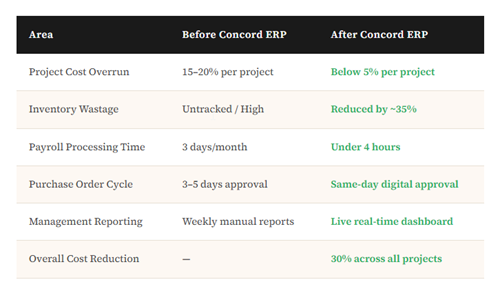
Six months after going live with Concord ERP, here's what changed at Rajesh Constructions:
Where Did the 30% Come From?
The 30% cost reduction didn't come from a single magic fix. It came from plugging multiple small leaks that individually seemed minor but collectively were draining the business:
Inventory control alone saved approximately 8–10% — materials were now tracked from indent to GRN to site usage, making it nearly impossible to lose stock without a record.
Better procurement decisions saved another 6–8% — with a proper quotation comparison system, the firm started choosing the most cost-effective vendors instead of defaulting to familiar ones.
Real-time budget alerts prevented overruns early, saving 8–10% that was previously lost by the time manual reports flagged the problem.
HR and payroll accuracy reduced salary errors and ghost entries, contributing a further 4–5% in monthly savings.
"Within 3 months, I could see exactly where every rupee was going — across all four sites — sitting in my office. That visibility alone was worth more than the software cost."
— Director, Rajesh ConstructionsWhy Concord ERP Worked Where Others Didn't
Rajesh Constructions had tried using a generic accounting software and a basic project tracker before this. Neither stuck. So what made Concord different?
It Was Built for Construction, Not Adapted for It
Concord ERP includes modules that only make sense for the construction industry — BOQ (Bill of Quantities) management, site-wise inventory tracking, sub-contractor billing, labour management with daily wages, and project-specific budget heads. These aren't afterthoughts. They're core features.
Cloud-Based with Mobile Access
Site supervisors could update attendance, raise material indents, and track task completion directly from their phones. The owner could check project profitability from anywhere. This real-time, anywhere access was a game changer for a firm managing multiple geographically spread sites.
Scalable as the Business Grew
As Rajesh Constructions added a fifth project mid-year, the system scaled without any disruption. New project, new budget heads, new team — all onboarded within hours. No IT infrastructure headaches, no additional servers.
Strong Implementation and Training Support
The Concord team didn't just hand over software and disappear. They were involved in data migration, team training, and workflow customization. For a non-tech-savvy construction firm, this handholding in the early weeks made all the difference.
Key Takeaways for Construction Business Owners
If you're running a construction firm in India and reading this story thinking "that sounds exactly like us" — you're not alone. Here's what the Rajesh Constructions experience teaches us:
Manual Systems Have a Hidden Cost
The cost of not having an ERP is rarely visible on a balance sheet. But it shows up every month as overruns, wastage, delayed decisions, and missed opportunities.
Construction ERP is Not Just for Big Firms
Concord ERP is designed for companies of all sizes — from small contractors managing 2 sites to large firms running 20+ projects simultaneously.
ROI Comes Faster Than You Think
Most firms recover the cost of ERP implementation within 6–9 months through savings on procurement, inventory, and payroll alone.
Visibility is the Real Superpower
When you can see everything in real-time, you stop firefighting and start planning. That shift in itself transforms how a business operates.
Final Thoughts
The construction industry in India is at a turning point. With RERA compliance requirements, GST reconciliation, and increasing project complexity, firms that continue to rely on Excel sheets and WhatsApp approvals are going to find themselves outpaced — not by competitors with better projects, but by competitors with better systems.
Rajesh Constructions didn't get lucky. They made a decision. They stopped accepting "this is just how construction works" and started asking "what if it could work better?"
The 30% cost reduction wasn't magic. It was visibility, accountability, and the right software working together.
If your construction business is facing similar challenges — budget overruns, inventory chaos, manual HR processes, or a complete lack of real-time reporting — the path forward is clear. And it starts with a free demo.
Ready to Cut Your Construction Costs?
Book a free demo of Concord ERP and see exactly how it can work for your business — with zero obligation.
Get Your Free Demo Today →📞 +91 9009155444 | 🌐 concorderp.com
Related Topics: construction ERP software India · how to reduce project costs in construction · best ERP for contractors India · construction project management software · cloud ERP for construction companies · ERP ROI in construction · Concord ERP case study · construction cost control software
© 2026 Concord ERP · Developed by Techwave IT Solutions Pvt. Ltd. · concorderp.com
 Any questions? Feel free to contact us.